
Lucky Break
Chapter Seven - No Tricks

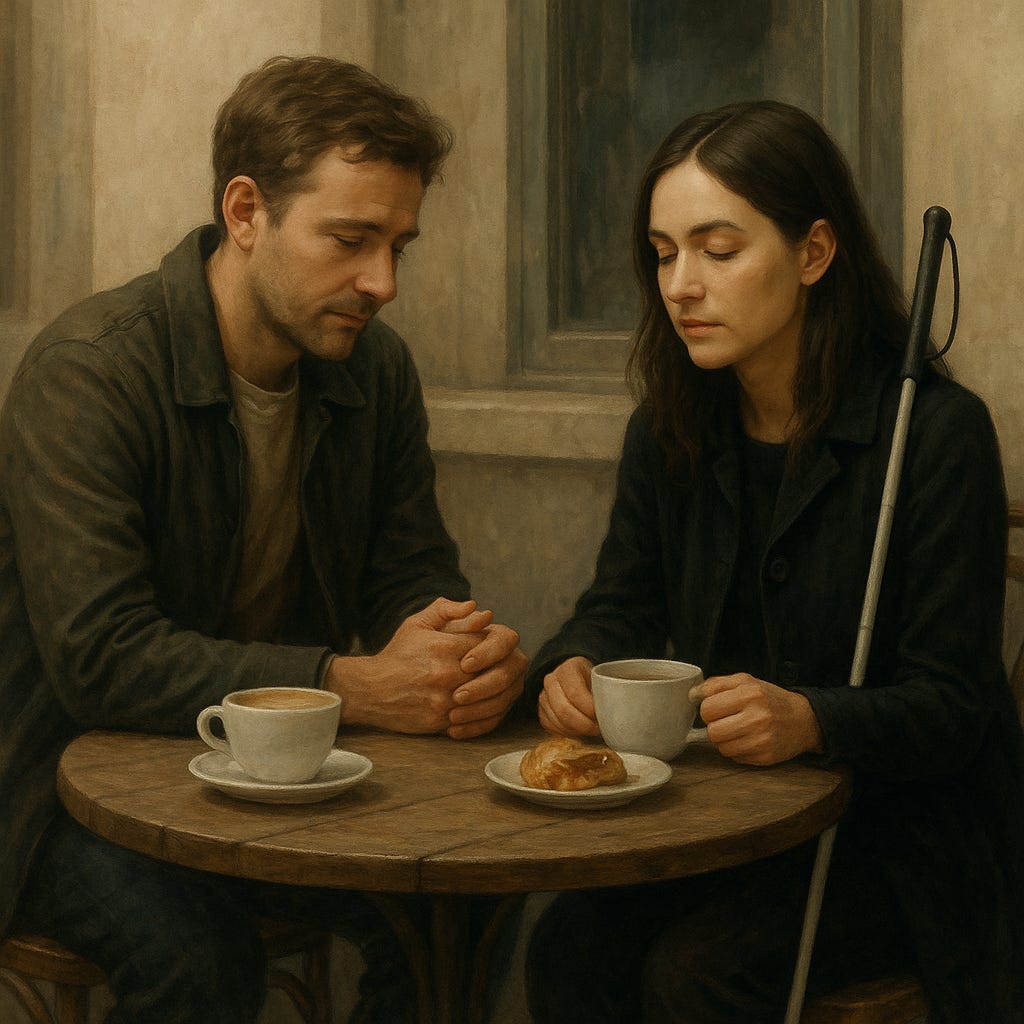
They met again two days later.
This time it was planned—at least in the loose, human sense of planning. A message. A time. A place. Nothing miraculous. Nothing that arrived on a gust of fate. Just Leo, sitting at the same outdoor table with a flat white cooling in front of him, checking his phone far too often and pretending this was normal behaviour for a man who had once drifted through life like it owed him smooth surfaces.
He’d been early.
He hated that.
Not because being early was bad, but because it was unfamiliar. The old Leo arrived exactly when he meant to arrive without ever checking the time. The new Leo arrived early because he’d left early because he’d checked the route because he’d made allowances for the universe not giving him freebies.
It felt like wearing someone else’s shoes. Serviceable. Sensible. Slightly uncomfortable, in a way that reminded him they weren’t broken in yet.
He adjusted the table wedge—receipt under the left leg—because he remembered. He tried not to feel proud of remembering. Pride felt like the wrong emotion now. Awareness was closer to the mark.
When Ronise arrived, it wasn’t with drama. No sudden spotlight. Just her presence sliding into the street’s rhythm like it belonged there.
Cane tapping lightly. Pace steady. Coat buttoned in a way that suggested she had better things to do than negotiate symmetry. She approached the café steps with the same quiet assurance he’d begun to associate with her, and for a second Leo felt the old reflex—the desire to be worthy in whatever way luck had always made him worthy.
Then she smiled when she reached him, and the reflex softened into something simpler.
“Hi,” she said.
“Hi,” Leo replied, and was absurdly relieved that he didn’t sound like an idiot this time.
“You’re early,” Ronise observed.
“I’m experimenting with punctuality,” Leo said. “It’s awful. I don’t recommend it.”
She laughed, settling into the chair opposite with a small, familiar efficiency. “It does make other people feel less anxious.”
“I hadn’t considered other people,” Leo said. Then winced. “That sounded worse than I meant.”
“It sounded honest,” Ronise said, and somehow made it not a condemnation.
Leo cleared his throat and gestured toward her cup. “The usual?”
“Yes,” Ronise said. “And I’m making a dangerous choice today.”
“Oh?” Leo leaned forward. “What kind of dangerous? Skydiving dangerous? Or texting your ex dangerous?”
“Pastry,” Ronise said. “I’m considering pastry.”
Leo sat back, impressed. “That’s the most reckless thing I’ve heard all week.”
“You don’t know my life,” Ronise said, deadpan.
He grinned. “I’m beginning to suspect you’re secretly a thrill seeker.”
Ronise’s smile widened, that quiet brightening he’d come to recognise. She turned her face slightly toward him, not to see but to orient. Leo noticed how naturally she did it, how little effort it seemed to take. He wondered how many things in his own life he’d coasted past simply because they’d never demanded effort.
They fell into conversation—uneven, human, occasionally interrupted by the clatter of cups or the scrape of chairs. Leo told her about the ferret podcast incident, embellishing only where timing demanded it. Ronise listened with the particular attentiveness of someone who wasn’t waiting for her turn to speak.
Then, inevitably, Leo said the wrong thing.
It wasn’t cruel. It wasn’t dramatic. It was the kind of mistake people made when they were used to metaphors arriving without consequences.
“And the weird part,” Leo said, “was that it made me realise how much I’ve been walking around like… I don’t know… like I’ve been blind to everything.”
The word landed.
Leo felt it instantly—not as guilt, but as clarity. A sharp awareness of a line he’d crossed without looking down.
Ronise’s fingers stilled on the rim of her cup.
The street noise seemed to recede slightly, as if the moment had narrowed its focus.
Leo’s instinct flared—to joke, to qualify, to dilute the mistake with charm. He felt it rise and, deliberately, did nothing.
“I’m sorry,” he said quietly. “That was clumsy.”
Ronise didn’t rush to save him. That, he realised, was a kind of respect.
“I know what you meant,” she said eventually. “But words do work. Even when we don’t intend them to.”
Leo nodded, shame settling into something steadier—responsibility.
“You’re right,” he said. “I reached for a shortcut.”
“Yes,” Ronise said. “Most people do.”
The moment loosened—not erased, not excused, but absorbed. Leo felt something unfamiliar and oddly satisfying: the sense that he had stayed where the discomfort was, and survived it.
“I’m trying,” he said. “To pay attention. To stop assuming the world will clean up after me.”
Ronise’s expression softened. “That’s not nothing.”
They finished their coffees slowly. The afternoon light shifted. When Ronise stood to leave, Leo stood too, a little awkwardly.
“Same time next week?” he asked.
Ronise smiled, that inward, luminous smile he’d come to associate with truth rather than performance.
“Yes,” she said. “Same time next week.”
She walked away, cane tapping lightly, merging back into the city’s rhythm.
Leo sat for a moment after she’d gone.
He had not dazzled. He had not been rescued.
He had paid attention.
And for the first time in his life, that felt like enough.
If you have read the first six chapters, and enjoyed them, please
or even if you hated them!