Lucky Break
Chapter Sixteen - Ronise

Ronise noticed before Leo said anything.
He had learned, by now, that she did not listen for confession. She listened for shift — the way a person stood when something had rearranged itself inside them. Not posture, exactly. Orientation. As if the body knew before language caught up. It was a skill she had developed out of necessity and refined into something close to instinct. Attention, when redistributed, became precise.
They were walking along the river in the late afternoon, the light thinning into gold and then something quieter, less declarative. The path curved gently here, pulling them away from the noise of traffic. The city loosened its grip. Sounds stretched and softened: water moving over itself, a dog barking somewhere distant, the hollow clack of a cyclist passing behind them.
Ronise’s cane tapped lightly ahead of her, testing, confirming, releasing. Leo matched her pace without thinking about it. He realised this a moment later and felt a small, private satisfaction. There had been a time when he’d had to remind himself. Now his body seemed to understand before his mind interfered.
“You’re heavier,” Ronise said, without slowing.
Leo smiled. “I was hoping that wasn’t obvious.”
“It’s not,” she replied. “It’s noticeable. Those aren’t the same.”
They reached a bench overlooking the water and sat. The wood was still warm from the day. Leo rested his forearms on his thighs and watched the surface of the river fracture light into pieces too small to hold onto. Somewhere nearby, a busker was playing — badly, but with commitment. A melody Leo half-recognised bent itself into something rougher, truer.
“I was offered something,” he said.
Ronise turned her head slightly toward him — not in anticipation, not in demand. Availability. He had come to recognise that posture too.
“An offer is rarely just one thing,” she said.
He nodded. “This one definitely wasn’t.”
He let the silence hold while he chose not the words, but the register. He was learning that how something was said mattered more than how completely it was explained.
“I don’t want it to sound dramatic,” Leo said. “Or impressive. Or like I’m about to disappear into a robe and start speaking in riddles.”
Ronise smiled. “That would be unfortunate. You’d be terrible at riddles.”
“That’s what I thought,” he said, relieved. “It’s more… an invitation. To pay attention. Properly. To moments where something is about to tip. Not to fix them. Just to be there when they do.”
Ronise nodded slowly. “And that feels new to you.”
“Yes,” Leo said. “And not new at all to you.”
She accepted that without comment.
“I don’t want to make you part of it,” he added after a moment. “Not as consequence. Not as collateral.”
Ronise turned toward him then, her expression calm but unmistakably firm. “Don’t confuse not asking with not allowing.”
Leo frowned. “I don’t want you to feel responsible for—”
“I won’t,” she said gently. “Because I know what’s mine and what isn’t. That’s one of the advantages of living in a world that doesn’t rearrange itself for you.”
He smiled. “You make that sound almost appealing.”
“It can be,” Ronise said. “If you let it teach you where your edges are.”
They sat again, neither of them speaking. Leo noticed how much effort it would have taken, once, to let the quiet stretch like this without filling it. Now it felt earned rather than awkward. He could feel the weight in his chest — not pressure, not dread. Density. The presence of something he was no longer pretending wasn’t there.
“I’m afraid of becoming distant,” Leo said quietly.
Ronise took her time. “Distance isn’t created by responsibility,” she said. “It’s created by pretending you don’t have one.”
That settled something in him. Not solved it. Settled it.
They stood and continued walking, the path narrowing, the river drawing closer. Ronise slipped her arm through his without comment — not for balance, not for navigation. Just contact, chosen and unremarkable. Leo felt the difference immediately.
“You know,” she said, “people think blindness is about absence. About what’s missing.”
“And it’s not?”
“It’s about redistribution,” Ronise replied. “Attention goes elsewhere. Listening deepens. Touch becomes information instead of reassurance.”
Leo nodded. “That sounds familiar.”
She smiled. “It should.”
They walked on, the city adjusting itself around them rather than intruding. Leo noticed how little he wanted to explain himself now. The old impulse — to narrate, to justify, to frame — had quieted. What remained felt steadier. More honest.
At the point where they would part, Ronise stopped.
“You don’t have to tell me everything,” she said. “But you do have to keep telling me where you are.”
Leo met her gaze. “I can do that.”
“I know,” she replied.
She leaned in and kissed him — not tentative, not lingering. A kiss that acknowledged presence rather than promise. When she stepped back, her face held that quiet beauty again. Not dazzling. Not posed. Simply unguarded.
“Go,” she said softly. “You’ve got weight to carry.”
Leo smiled. “And you?”
“I’ve always had mine,” Ronise said. “I just carry it differently.”
She turned and walked away, cane tapping gently against the pavement, receding into the evening without ceremony.
Leo remained where he was a moment longer, not watching her go, but feeling the space she had left behind — not empty, not aching. Defined.
He thought of Kevin, resting somewhere at last, no longer holding everything himself. Of Ruth, who would recognise this version of him immediately and call it something unsentimental and accurate. Of the city, still loud, still imperfect, still requiring attention.
For the first time, the weight did not feel like something he might set down later.
It felt like something he had learned how to hold.
And as he turned toward home, the night opening around him without resistance, Leo understood that luck had never really left him.
It had simply stopped doing the work for him.
And that, he realised, was the truest break of all.
This is the end of Lucky Break. Thank you for joining Leo and Ronise on their journey together. I hope you’ve enjoyed it. If you want to share Reality B-Sides, the link is below. If you enjoyed this, then the Coda below is for you.
Coda
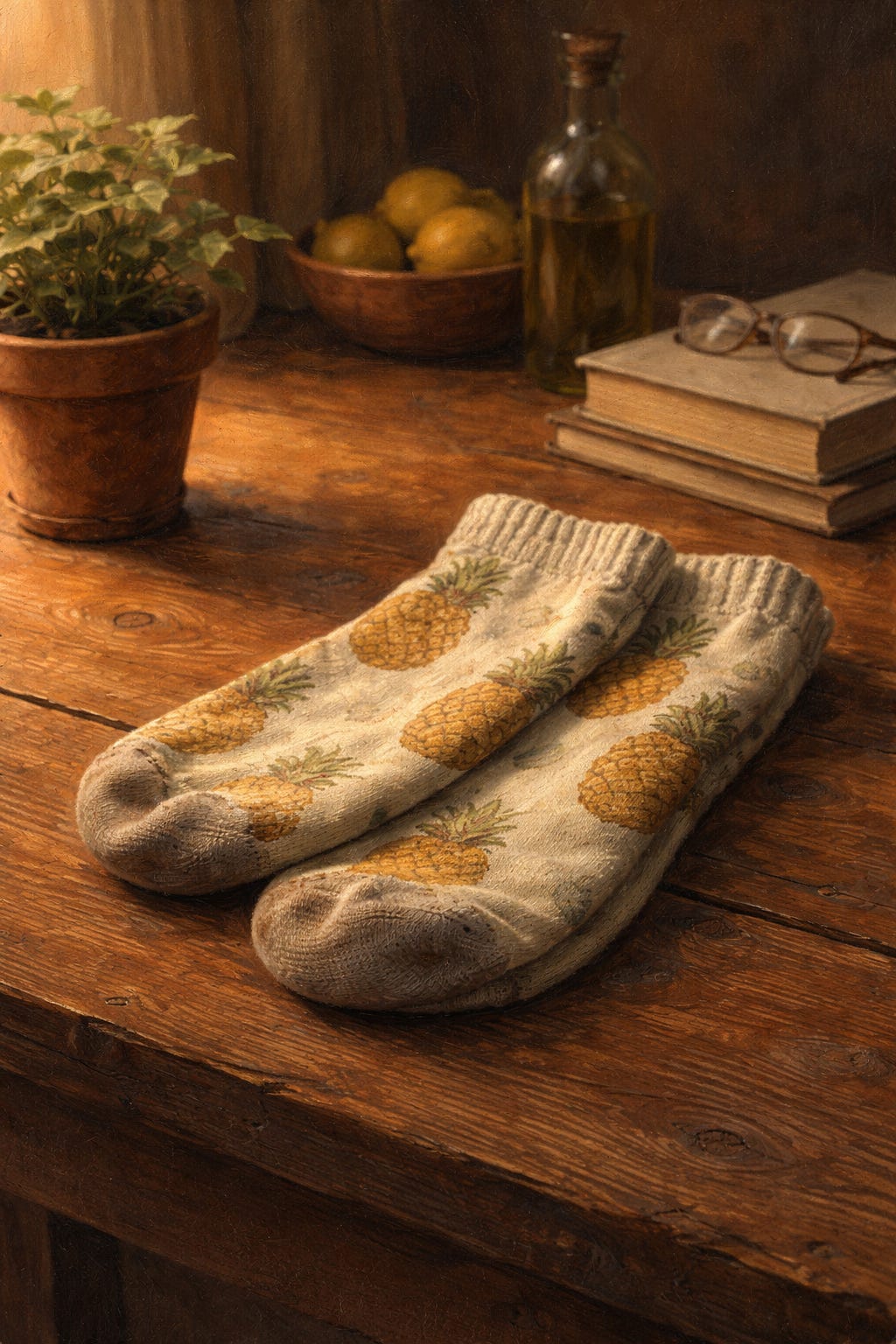
The socks finally wore out in May.
Not dramatically. No tear down the heel, no symbolic unraveling. Just thinning fabric, elastic that no longer believed in its own job, pineapples faded into abstract shapes that looked less smug and more tired.
Leo noticed one morning as he pulled them on and felt his toes touch the cold floor through places they shouldn’t have. He stood there for a moment, balanced awkwardly, sock half-on, half-off, and laughed.
“Fair enough,” he said to no one.
He didn’t throw them away straight away. He washed them. Folded them. Put them back in the drawer with a kind of gentle ceremony that would have embarrassed his earlier self. Later that week, he repurposed them as cleaning rags. They did an adequate job on the kitchen counter and a surprisingly good one on the inside of the microwave.
Luck, it turned out, was very useful when reassigned.
Life continued.
Not smoothly. Not cruelly. Just at cost.
Leo recorded fewer podcast episodes, but the ones he did make were quieter, longer, more deliberate. Listeners wrote in to say they felt seen, though none of them could quite explain why. He stopped chasing guests who dazzled and started inviting people who noticed things. The audience shrank a little. The conversations deepened a lot.
Ronise stayed.
Not as anchor. Not as reward. As presence.
They learned each other’s rhythms slowly, without the false intimacy of confession-as-currency. Some days they talked. Some days they didn’t. Leo learned that silence didn’t mean absence, and Ronise learned that his attention, when offered, was careful rather than consuming.
Ruth visited once a month and diagnosed his progress with surgical precision.
“You’re less irritating,” she told him one afternoon. “Which is how I know this is real.”
Kevin didn’t disappear entirely.
Sometimes Leo caught the faint smell of toast on the air, usually when he was about to rush or assume or intervene unnecessarily. It functioned less as warning now and more as reminder.
Pause. Adjust. Then decide.
Leo never asked what Kevin did with his time. He suspected rest was not a location but a redistribution.
There were days Leo missed the old ease. Days when he watched other people glide and felt a flicker of envy so sharp it surprised him. But it passed more quickly now, replaced by something sturdier.
Orientation.
One evening, months later, Leo stood at the same river where he and Ronise had walked so many times before. The water moved as it always had, indifferent and patient. He thought of the version of himself who had once believed luck was something that happened to you.
He smiled.
Luck, he understood now, wasn’t the absence of consequence.
It was the chance to choose how to carry it.
Leo turned toward home, hands in his pockets, steps unhurried.
The world did not rearrange itself for him.
And for the first time, he was grateful for that.
Because the break he’d been given—the only one that really mattered—was not from difficulty, or effort, or weight.
It was from needing the universe to do the work for him.
And that, finally, felt like luck.
THE END.